Tag: Nerdio Manager for Enterprise

  • Habit #7: Optimise Log Analytics

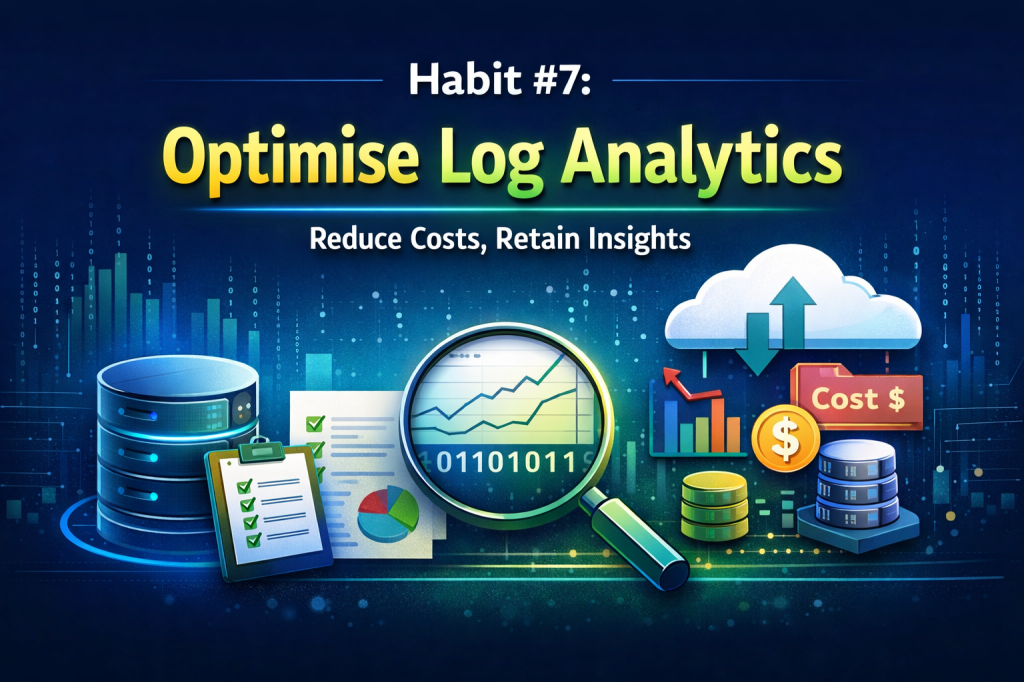
    Habit #7: Optimise Log Analytics

    Visibility is essential — but it shouldn’t come at any cost.

    Monitoring is a critical part of running Azure Virtual Desktop.

    Without it, you’re blind to performance issues, login delays, and user experience problems.

    But there’s a trade-off that many teams don’t fully realise:

    Observability isn’t free.

    And in many environments, Log Analytics quietly becomes one of the largest — and least optimised — costs in Azure.

    That’s where Habit #7 comes in.

    Highly effective admins don’t just enable monitoring.
    They optimise it.


    The Hidden Cost of Visibility

    Log Analytics is incredibly powerful.

    It provides deep visibility into:

    • Session performance
    • User experience
    • Host health
    • Application behaviour

    But it works by ingesting data.

    And in Azure, you don’t pay for storing most of that data (at least initially).
    You pay for ingesting it.

    That means:

    The more frequently you collect data, the more you pay.

    In many AVD environments, default configurations collect data far more frequently than needed for day-to-day operations.

    The result?

    High ingestion volumes… and unexpectedly high costs.


    What Log Analytics Optimisation Really Means

    Optimising Log Analytics isn’t about turning monitoring off.

    It’s about collecting the right data, at the right frequency, for the right purpose.

    In Nerdio Manager for Enterprise, admins have control over how telemetry is collected and retained.

    This includes:

    • Data collection frequency (polling intervals)
    • Performance counters being captured
    • Retention periods

    The goal isn’t to reduce visibility.

    It’s to remove unnecessary noise.


    The Three Pillars of Habit #7

    Like every habit in this series, this comes down to consistent, repeatable behaviour.


    Pillar 1: Review What You’re Collecting

    Most environments collect far more data than they actually use.

    Highly effective admins regularly review:

    • Which performance counters are enabled
    • Whether those metrics are actively used
    • Which dashboards or reports depend on them

    A simple question helps guide this:

    “If we stopped collecting this data, would anyone notice?”

    If the answer is no, it’s likely unnecessary.


    Pillar 2: Adjust Collection Frequency

    One of the biggest cost drivers in Log Analytics is how frequently data is collected.

    By default, many metrics are captured every 30 seconds.

    For most environments, that level of granularity isn’t required.

    Adjusting polling intervals to:

    • 60 seconds
    • 120 seconds
    • Or even longer for certain metrics

    …can significantly reduce ingestion volume without materially impacting visibility.

    The data is still there.

    It’s just collected more efficiently.
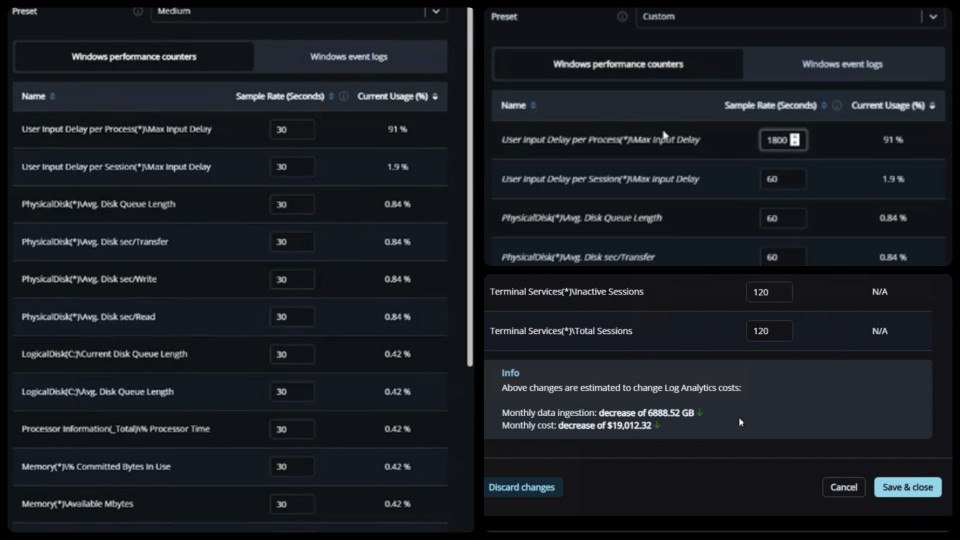
    Log Analytics Optimisation in Nerdio Manager.

    Pillar 3: Align Retention with Real Needs

    Not all data needs to be kept forever.

    Highly effective admins:

    • Align retention periods with operational requirements
    • Keep short-term data for troubleshooting
    • Retain longer-term data only where it adds value

    For many teams, a 30-day retention window is more than sufficient for operational analysis.

    Anything beyond that should be intentional.


    What This Habit Enables

    When Log Analytics is optimised properly:

    • Monitoring costs drop significantly
    • Data ingestion becomes predictable
    • Dashboards remain effective
    • Troubleshooting capability is preserved

    Most importantly:

    You maintain visibility — without overpaying for it.


    Common Mistakes to Avoid

    Log Analytics optimisation is often overlooked or misunderstood.

    Some common pitfalls include:

    • Leaving default collection settings unchanged
    • Collecting high-frequency data that’s never used
    • Retaining data longer than necessary
    • Reducing data collection too aggressively without understanding impact

    The goal is balance.

    Too much data increases cost.
    Too little data reduces visibility.


    How Habit #7 Builds on the Previous Habits

    By this stage, the environment should already be well optimised:

    • Images are standardised
    • Patching is predictable
    • Applications are decoupled
    • Autoscale is tuned
    • VM sizing is aligned with demand

    Habit #7 completes the picture.

    It ensures that the monitoring layer itself is optimised, not just the infrastructure it observes.


    The Real Takeaway

    Monitoring is essential.

    But more data doesn’t always mean more value.

    Highly effective admins understand this.

    They don’t collect everything.

    They collect what matters.

    And they do it efficiently.


    Closing the Series

    That’s the final habit in the series.

    The 7 Habits of Highly Effective Nerdio Admins aren’t about individual features.

    They’re about operational discipline:

    • Build consistently
    • Patch predictably
    • Separate concerns
    • Optimise continuously
    • Use data to drive decisions

    Individually, each habit adds value.

    Together, they create environments that are:

    • Stable
    • Scalable
    • Cost-efficient
    • Predictable

    And ultimately — easier to manage.
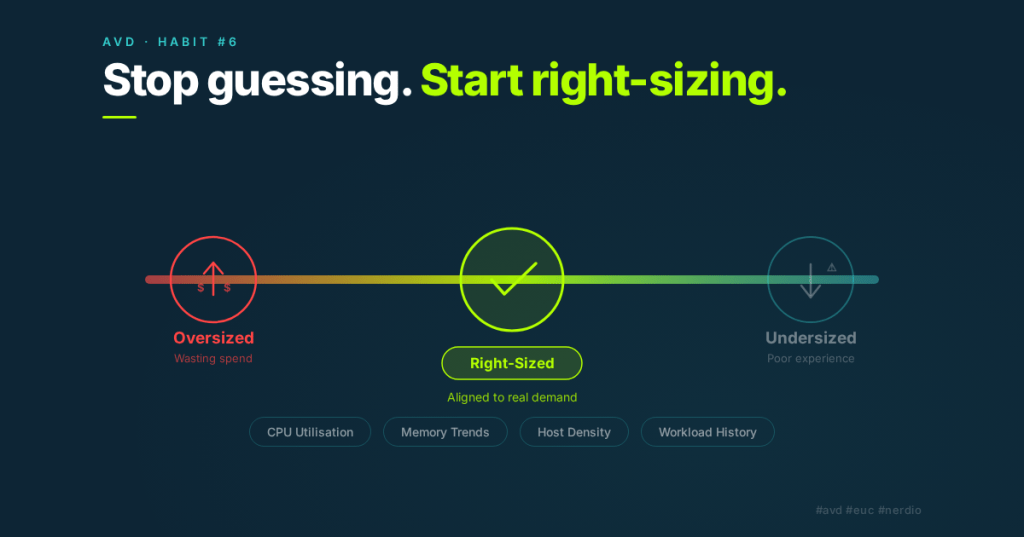
  • Habit #6: Regularly Right-Size Using Nerdio Advisor

    Habit #6: Regularly Right-Size Using Nerdio Advisor

    The environment you designed six months ago probably isn’t the environment you’re running today.

    Most Azure Virtual Desktop environments start out well-designed.

    VM sizes are carefully chosen.
    Host pool capacity is planned.
    Autoscale is configured.

    At the beginning, everything fits.

    But environments rarely stay static.

    Users come and go.
    Applications change.
    Workloads evolve.

    Over time, what was once the right size often becomes the wrong size.

    That’s why Habit #6 exists.

    Highly effective admins don’t assume their original VM sizing decisions are still correct.

    They validate them regularly.


    Environment Drift Is Inevitable

    Even the most disciplined environments drift.

    Over time, you may see:

    • Increased user density on session hosts
    • New applications changing resource demands
    • Departments adopting new workflows
    • Seasonal fluctuations in usage

    None of this means that something was configured incorrectly.

    It simply means the environment evolved.

    The risk comes when sizing decisions stay frozen while everything else changes.

    That’s where right-sizing becomes essential.


    What Right-Sizing Actually Means

    Right-sizing isn’t about aggressively shrinking VM sizes.

    It’s about aligning infrastructure with real demand.

    In Nerdio Manager for Enterprise, Nerdio Advisor helps surface opportunities where VM sizes or host counts no longer match usage patterns.

    It analyses:

    • CPU utilisation trends
    • Memory utilisation
    • Host density
    • Historical workload behaviour

    From this data, it can highlight potential opportunities to:

    • Reduce VM size
    • Adjust host counts
    • Improve session density
    • Eliminate unused capacity

    Advisor doesn’t force changes.

    It simply shows where optimisation may exist.


    The Three Pillars of Habit #6

    Like the other habits in this series, right-sizing becomes effective when it’s treated as a repeatable behaviour rather than a one-time task.


    Pillar 1: Review Advisor Recommendations Regularly

    Right-sizing should be part of your operational rhythm.

    Highly effective admins review Advisor recommendations periodically to understand how their environment is evolving.

    These reviews help answer questions such as:

    Are hosts consistently underutilised?
    Are machines running close to resource limits?
    Has user demand changed since the environment was first deployed?

    Looking at these trends regularly prevents small inefficiencies from turning into long-term overspend.


    Pillar 2: Validate Host Pool Sizing Against Real Demand

    Advisor recommendations are a starting point.

    Before making changes, administrators should validate recommendations against how the environment is actually used.

    Important considerations include:

    • Login storms
    • Peak usage periods
    • Critical applications
    • Future growth expectations

    Right-sizing should always balance efficiency with user experience.

    The goal is optimisation — not risk.


    Pillar 3: Make Incremental Adjustments

    The most successful optimisation strategies are gradual.

    Highly effective admins:

    • Test smaller VM sizes in validation pools
    • Adjust session density carefully
    • Monitor performance after changes
    • Iterate based on real results

    This approach ensures improvements are sustainable and predictable.

    Large, aggressive changes introduce uncertainty.

    Small, measured adjustments build confidence.


    What This Habit Enables

    When environments are regularly right-sized, several things happen.

    First, infrastructure becomes more efficient.

    Unused capacity is eliminated, and VM sizes better match the workloads they support.

    Second, costs become more predictable.

    Right-sizing ensures organisations are paying for what they actually use — not what they once needed.

    Finally, operational confidence improves.

    Administrators know their environment reflects current demand rather than historical assumptions.


    Common Mistakes to Avoid

    Right-sizing is powerful, but it can be misunderstood.

    Some common pitfalls include:

    • Treating right-sizing as a one-time exercise
    • Blindly applying recommendations without validation
    • Optimising based on short-term usage spikes
    • Reducing VM sizes too aggressively

    Good optimisation is disciplined.

    It balances cost efficiency with stability.


    How Habit #6 Builds on the Previous Habits

    By the time organisations reach Habit #6, the earlier habits have already created a stable foundation.

    Images are standardised.
    Patching is predictable.
    Applications are decoupled from images.
    Autoscale behaviour is understood.

    Only once that foundation exists does right-sizing become safe.

    Without it, changing VM sizes can introduce instability.

    With it, right-sizing becomes one of the most powerful cost optimisation tools available.


    The Real Takeaway

    Infrastructure decisions age.

    What worked six months ago may not be optimal today.

    Highly effective admins recognise this.

    They don’t rely on past assumptions.

    They validate them.

    Regular right-sizing ensures that the environment you’re running today reflects the demands of today — not the design decisions of yesterday.

    That’s the essence of Habit #6.


    Next in the series:
    Habit #7 — Optimise Log Analytics

    Monitoring is essential for maintaining visibility into your environment, but unmanaged telemetry can quietly inflate Azure costs. The final habit explores how to maintain observability while keeping analytics costs under control.

  • Habit #5: Analyse Auto-Scale History

    Habit #5: Analyse Auto-Scale History

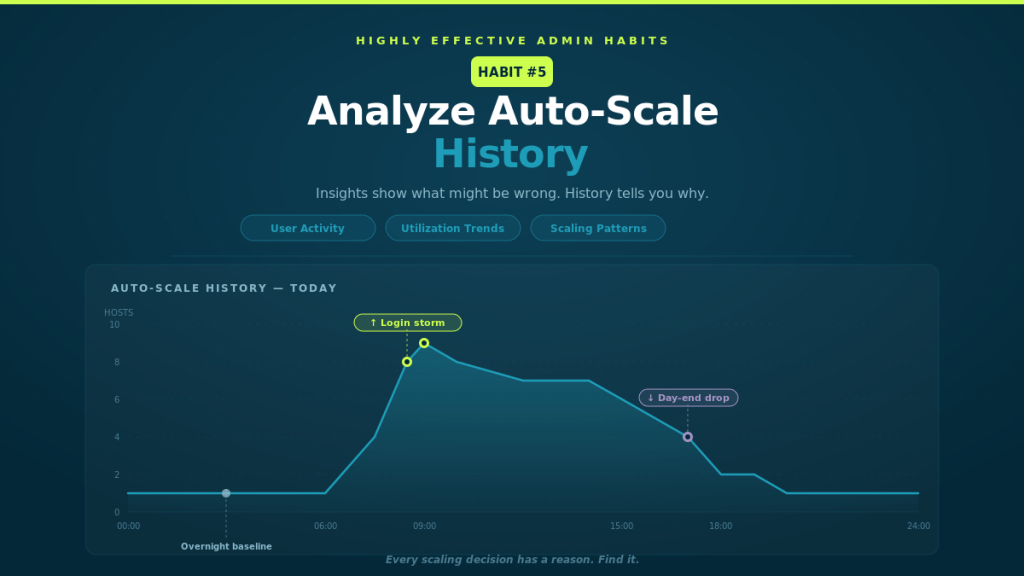
    Insights show what might be wrong. History tells you why.

    Auto-scale is designed to react to demand.

    Users log in → hosts scale out.
    Users log off → hosts scale in.

    Simple in theory.

    But in the real world, Auto-Scale behaviour can sometimes look confusing:

    • Hosts scale out earlier than expected
    • Machines stay online when no users remain
    • Capacity spikes suddenly
    • Scaling appears inconsistent

    When this happens, many admins immediately start tweaking auto-Scale settings.

    The most effective admins do something different first.

    They look at the history.


    Auto-Scale Behaviour Often Tells a Story

    When Auto-Scale behaves in ways that seem unexpected, it’s rarely a bug.

    More often, it’s Auto-Scale doing exactly what it was configured to do — just reacting to signals you might not have noticed.

    Auto-Scale makes decisions based on inputs such as:

    • Active user sessions
    • CPU utilisation
    • Memory utilisation
    • Session limits
    • Time-based schedules

    If any of these signals change, Auto-Scale responds.

    Without reviewing historical behaviour, those responses can feel random.

    But once you analyse the history, patterns start to emerge.


    What Auto-Scale History Reveals

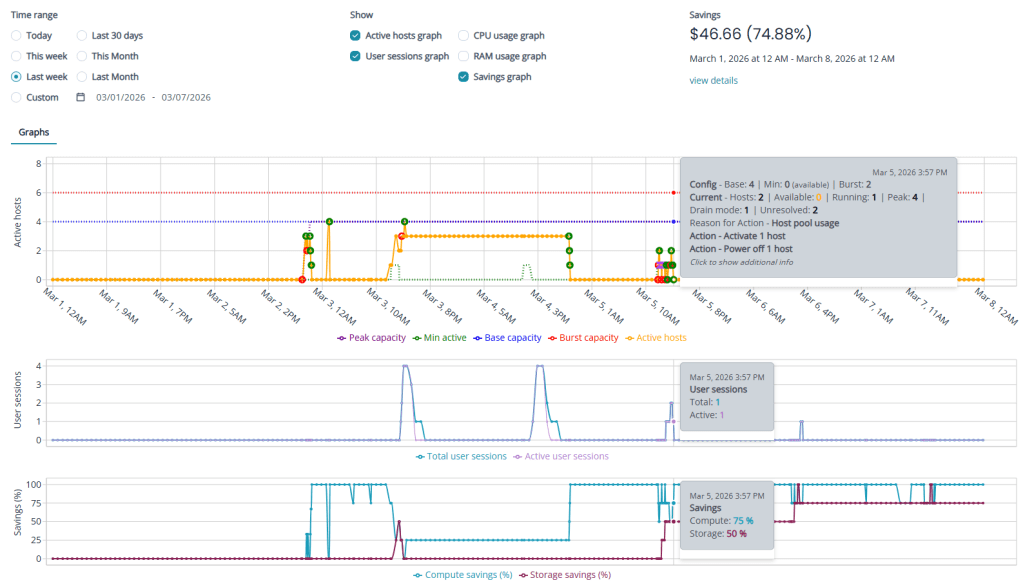
    Auto-Scale History in Nerdio Manager for Enterprise provides a timeline of scaling behaviour so you can understand exactly what happened.

    It allows administrators to see:

    • When scale-out events occurred
    • When hosts scaled back in
    • What triggered each scaling decision
    • How host capacity changed throughout the day

    Instead of guessing why Auto-Scale reacted, you can see the reasoning behind every action.

    This turns Auto-Scale from a black box into an explainable system.


    The Three Pillars of Habit #5

    Highly effective admins don’t just glance at Auto-Scale history when something goes wrong.

    They analyse it regularly.

    Three behaviours make this habit effective.


    Pillar 1: Correlate Scale Events with User Activity

    Auto-Scale should follow user demand.

    That means scale-out events should align closely with increases in user sessions.

    By reviewing Auto-Scale history alongside session activity, you can identify patterns such as:

    • Morning login storms
    • Midday workload peaks
    • Shift-based usage patterns
    • End-of-day session drop-offs

    When scaling events align with user behaviour, your Auto-Scale configuration is doing its job.

    If scaling happens too early or too late, it may indicate that thresholds or session limits need adjustment.

    The key is understanding how demand drives capacity.


    Pillar 2: Analyse Resource Utilisation Trends

    User sessions alone don’t tell the whole story.

    Resource utilisation often reveals why Auto-Scale behaves the way it does.

    Review historical trends for:

    • CPU utilisation
    • Memory utilisation
    • Average sessions per host

    These metrics help answer important questions:

    Are hosts consistently underutilised?
    Are machines running near capacity?
    Are session limits too conservative?

    In many environments, utilisation data quickly reveals opportunities to right-size VM families or adjust session density.

    Without this context, Auto-Scale decisions can appear unpredictable.

    With it, they become completely logical.


    Pillar 3: Identify Inefficient Scaling Patterns

    Auto-Scale history also helps reveal inefficiencies that quietly increase costs.

    Examples include:

    • Hosts running overnight with no active sessions
    • Scale-out events creating more hosts than needed
    • Frequent scale-in and scale-out oscillations
    • Burst hosts being created unnecessarily

    One-off events rarely matter.

    Patterns do.

    When these patterns appear repeatedly, they often indicate that scaling thresholds or schedules can be refined.

    Small adjustments can eliminate significant waste over time.


    What This Habit Enables

    When administrators regularly analyse Auto-Scale history, scaling becomes predictable.

    Instead of reacting to unexpected behaviour, teams gain:

    • Clear visibility into scaling decisions
    • Faster troubleshooting when anomalies occur
    • Evidence-based optimisation
    • Improved cost control
    • Greater confidence in Auto-Scale configuration

    Auto-Scale stops feeling mysterious.

    It becomes something you understand and control.


    Common Mistakes to Avoid

    Even experienced teams can misinterpret Auto-Scale behaviour.

    Some common pitfalls include:

    • Reviewing only one day of historical data
    • Optimising around short-term anomalies
    • Ignoring weekly or seasonal usage patterns
    • Adjusting Auto-Scale settings without understanding triggers

    Auto-Scale optimisation works best when decisions are based on consistent trends rather than isolated events.

    Looking at several weeks of history often reveals the true behaviour of an environment.


    How Habit #5 Builds on Habit #4

    Habit #4 focused on Auto-Scale Insights.

    Insights help surface potential optimisation opportunities — such as idle capacity or oversized VM SKUs.

    Habit #5 goes one step further.

    It explains why those opportunities exist.

    When you combine insights with historical analysis, you create a powerful feedback loop:

    Insights highlight optimisation opportunities.
    History explains the behaviour behind them.

    Together, they allow admins to refine Auto-Scale configurations with confidence.


    The Operational Discipline Behind Great Environments

    The most stable Azure Virtual Desktop (AVD) environments don’t rely on trial and error.

    They rely on observation.

    Highly effective teams treat Auto-Scale history as part of their operational routine.

    They review it:

    • During monthly environment reviews
    • When investigating performance issues
    • After major application or user changes
    • When evaluating cost optimisation opportunities

    Over time, this creates a deeper understanding of how the environment behaves.

    And that understanding leads to better decisions.


    The Real Takeaway

    Auto-Scale isn’t magic.

    It’s simply a system responding to signals.

    When those signals are understood, scaling becomes predictable.

    And predictable systems are easier to optimise.

    That’s the real value of Habit #5.


    Next in the series:
    Habit #6 — Regularly Right-Size Using Nerdio Advisor

    Even well-designed environments drift over time. The most effective admins continuously validate that their VM sizing still reflects real demand.

  • Habit #4: Act on Auto-Scale Insights

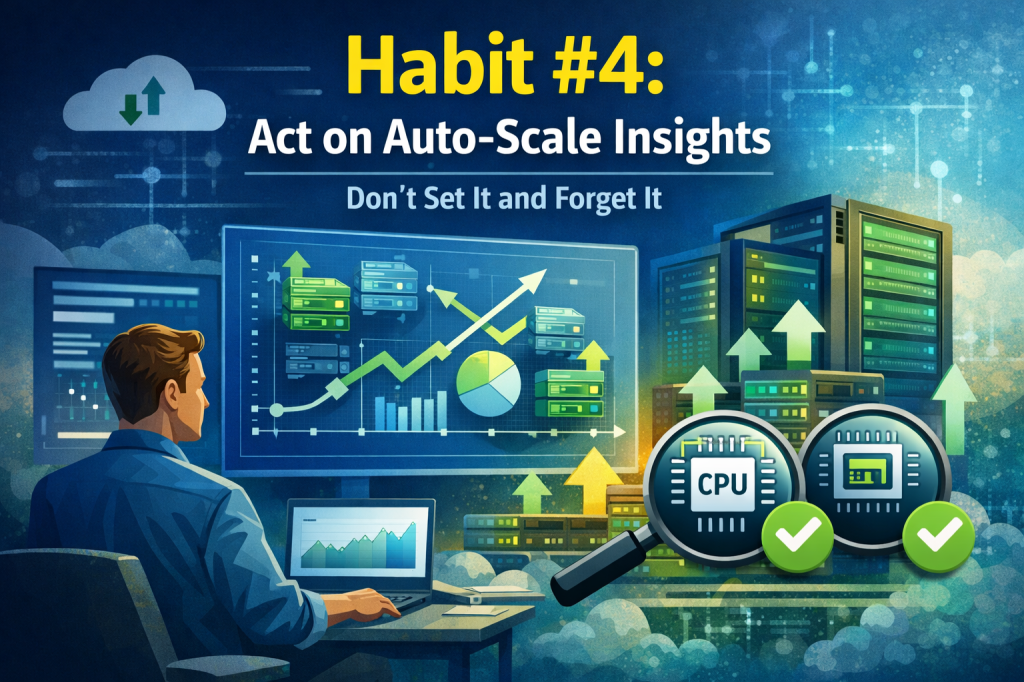
    Habit #4: Act on Auto-Scale Insights

    Don’t set it and forget it.

    Auto-scale is one of the most powerful features in Azure Virtual Desktop.

    It promises elasticity.
    It promises cost control.
    It promises performance stability.

    But here’s the reality:

    Most environments drift.

    Auto-scale gets configured once — often during deployment — and then quietly left alone. Months later, usage patterns have changed, user numbers have shifted, and application behaviour has evolved… but scaling logic hasn’t.

    That’s where Habit #4 comes in.

    Highly effective Nerdio admins don’t treat auto-scale as a static configuration.
    They treat it as a feedback loop.


    Auto-Scale Drift Is Normal

    Even well-designed environments don’t stay optimal forever.

    Over time:

    • Users join or leave
    • Working hours shift
    • Seasonal spikes come and go
    • Applications change resource profiles

    None of this means the original configuration was wrong.

    It just means the environment evolved.

    The problem isn’t drift.
    The problem is ignoring it.


    What Auto-Scale Insights Actually Do

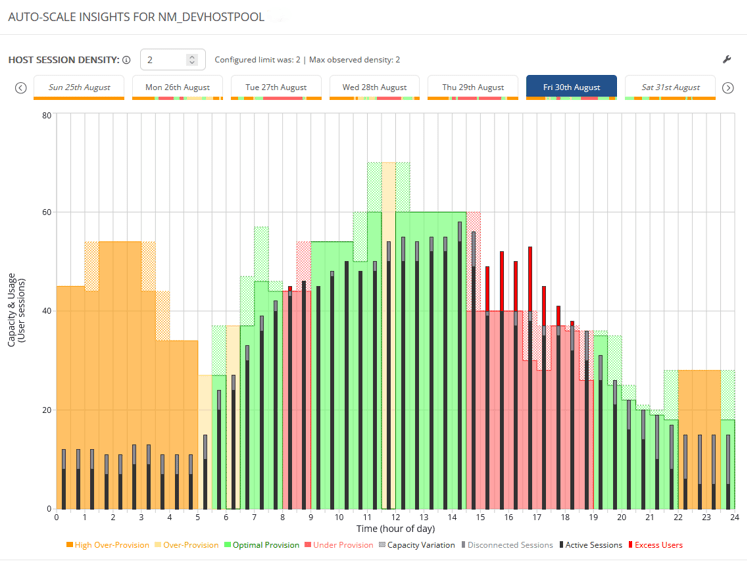
    Auto-Scale Insights in Nerdio Manager for Enterprise surface where your configuration no longer reflects reality.

    They highlight:

    • Idle capacity
    • Inefficient scaling schedules
    • Burst logic that may be too conservative — or too aggressive

    Insights don’t make changes for you.
    They show you where opportunity exists.

    They turn instinct into evidence.


    The Three Pillars of Habit #4

    Like the other habits, this one breaks down into repeatable behaviours.

    You don’t need a dramatic reconfiguration.
    You need a disciplined review.


    Pillar 1: Review Insights Regularly

    Auto-scale should have an operational cadence.

    Highly effective admins:

    • Review Insights monthly (or at minimum quarterly)
    • Look for trends, not one-off anomalies
    • Treat it like a performance and cost dashboard

    Small adjustments made regularly compound over time.

    What’s dangerous isn’t one imperfect configuration.
    It’s leaving it untouched for a year.


    Pillar 2: Validate Provisioning Against Real Usage

    The question isn’t “Is autoscale enabled?”

    The question is:

    Does our current provisioning reflect how the environment is actually being used?

    Review:

    • Active and disconnected sessions per host
    • Scale-out frequency
    • Ramp, peak, and taper events
    • Host counts during low-demand periods

    As a general rule of thumb, sustained utilisation below ~60% often signals overprovisioning. Sustained utilisation above ~80% may indicate constrained performance.

    The goal isn’t to chase perfect numbers.

    The goal is alignment between capacity and demand.


    Pillar 3: Optimise Safely, Not Aggressively

    Cost optimisation should be invisible to users.

    Highly effective admins:

    • Adjust VM size incrementally
    • Modify session limits gradually
    • Tune burst thresholds cautiously
    • Validate performance after changes

    Aggressive optimisation introduces risk.

    Disciplined optimisation builds confidence.


    What This Enables

    When Auto-Scale Insights are acted on consistently:

    • Compute costs drop meaningfully
    • Scaling becomes predictable
    • Surprise overruns decrease
    • Performance stabilises

    More importantly, optimisation becomes a data exercise — not guesswork.

    This aligns strongly with my broader emphasis on disciplined, data-driven decision making.


    Common Mistakes to Avoid

    Even experienced teams fall into these traps:

    • Blindly applying every recommendation without context
    • Optimising based on one week of data
    • Ignoring seasonal workload patterns
    • Tuning autoscale before stabilising images and applications

    Order matters.

    Autoscale optimisation works best when:

    • Images are consistent
    • Patching is predictable
    • Applications are disciplined

    That foundation makes scaling behaviour easier to interpret — and safer to adjust.


    How Habit #4 Builds on the Foundation

    Habit #4 doesn’t stand alone.

    It builds on:

    • Habit #1: Standardised image management
    • Habit #2: Predictable patching
    • Habit #3: Controlled application delivery

    Only when the environment is stable does autoscale optimisation become safe.

    Otherwise, you’re just scaling instability faster.


    The Real Takeaway

    Autoscale isn’t about turning machines on and off.

    It’s about continuously aligning capacity with reality.

    Set it.
    Measure it.
    Refine it.

    That’s the habit.


    Next up: Habit #5 — Analyse Auto-Scale History
    Insights show what might be wrong. History tells you why.

  • Habit #3: Centralise and Automate Application Management

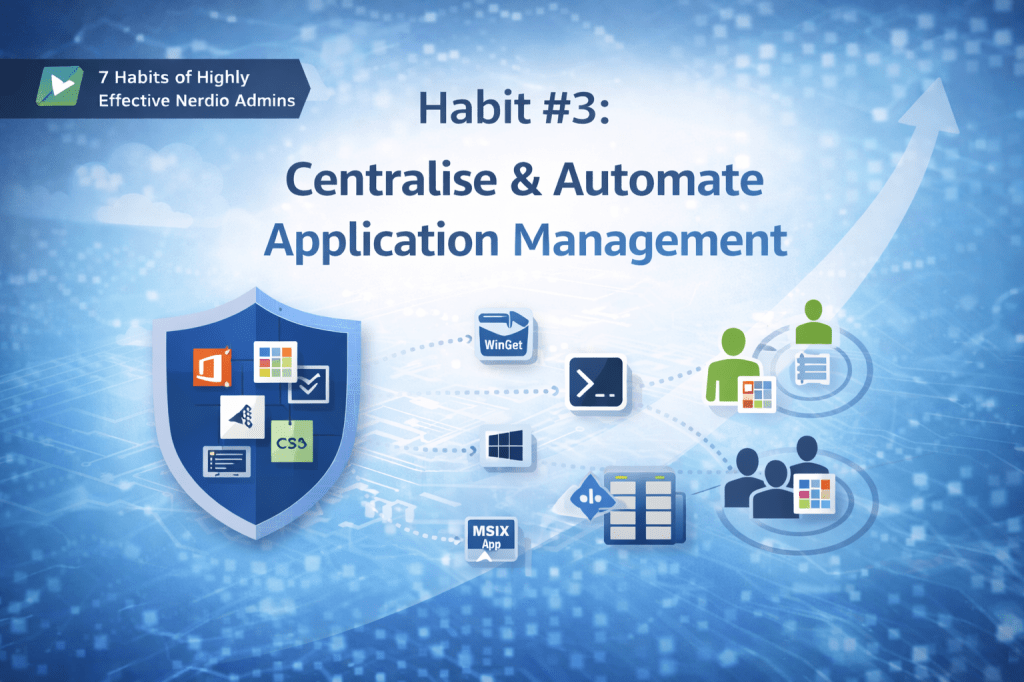
    Habit #3: Centralise and Automate Application Management

    Once desktop images are standardised and patching is automated, many environments hit the next friction point: application management.

    This is often where complexity quietly creeps back in.

    Applications are installed in different ways, updated inconsistently, and tied to specific images or host pools “just to make things work.” Over time, this undermines the stability gained from good image and patch discipline.

    Highly effective admins avoid this by treating application management as a centralised, automated operating model — not a collection of one-off installs.

    This is Habit #3.


    Why application sprawl undermines otherwise well-run environments

    In less mature AVD environments, application delivery tends to evolve organically:

    • Some apps are baked into images
    • Others are installed manually
    • Updates are handled inconsistently
    • Different teams use different tools

    Initially, this can feel flexible. At scale, it becomes fragile.

    Common symptoms include:

    • Bloated desktop images
    • Longer image rebuild and testing cycles
    • Unclear ownership of applications
    • Increased support tickets following updates

    The issue isn’t the tools — it’s the lack of a consistent operating model.


    The mindset shift: applications should not define your images

    Highly effective admins make a deliberate separation:

    Images provide the foundation. Applications provide the functionality.

    When applications are tightly coupled to images:

    • Every app update forces an image change
    • Testing effort increases
    • Rollbacks become harder and riskier

    Decoupling applications from images allows teams to:

    • Keep images minimal and stable
    • Update applications independently
    • Reduce the blast radius when something breaks

    This is where Nerdio Manager for Enterprise becomes a control plane for application delivery — not just a place to manage hosts.


    The three pillars of Habit #3

    Highly effective admins consistently apply three principles when managing applications.


    Pillar 1: Decouple applications from desktop images

    Images should change slowly. Applications often don’t.

    Highly effective admins:

    • Avoid baking applications into images unless there’s a clear technical reason
    • Keep images focused on OS configuration, runtimes, and baseline security
    • Allow applications to evolve independently of the image lifecycle

    This results in:

    • Faster image rebuilds
    • Lower testing overhead
    • More predictable recovery and rollback

    Key idea:

    Images provide stability. Applications provide flexibility.


    Pillar 2: Centralise app delivery into a single operating model

    Modern AVD environments require flexibility. Different applications need different deployment approaches.

    Highly effective admins embrace this reality — but they manage it centrally, rather than allowing application delivery to fragment.

    This may include:

    • Public or private WinGet packages
    • Scripted installs using Shell Apps or Scripted Actions
    • Intune-managed applications
    • MSIX app attach (where it makes sense)
    • Legacy tooling where required, such as SCCM

    The critical point isn’t which method is used — it’s that:

    • The choice is intentional
    • Deployment is automated
    • Behaviour is predictable

    Centralisation provides:

    • Clear visibility into how applications are delivered
    • Consistent update behaviour across environments
    • Faster troubleshooting when issues arise

    The result is flexibility without fragmentation.

    Key idea:

    Different tools. One control plane.


    Pillar 3: Assign applications by intent, not infrastructure

    A common anti-pattern is allowing application differences to dictate:

    • New images
    • New host pools
    • Environment-specific workarounds

    Highly effective admins avoid this by assigning applications based on intent, such as:

    • User role
    • Team or department
    • Business requirement

    Instead of asking:

    “Which host gets this app?”

    They ask:

    “Who actually needs this app?”

    This approach:

    • Reduces image and host pool sprawl
    • Simplifies onboarding and offboarding
    • Keeps environments easier to reason about

    Importantly, this does not require App Attach. User- or group-based assignment can be achieved through multiple delivery methods, with App Attach used selectively where it provides clear value.

    Key idea:

    Apps should be delivered by need — not by where a user logs in.


    Automate application updates deliberately

    Application updates are one of the most common sources of instability.

    Highly effective admins:

    • Automate updates where appropriate
    • Control timing and scope
    • Avoid surprise changes during business hours

    Just like OS patching, application updates work best when treated as a repeatable workflow, not an ad-hoc task.

    Automation doesn’t remove control — it formalises it.


    The operational payoff

    When application management is centralised and automated:

    • Images remain lean
    • Updates become predictable
    • Rollbacks are simpler
    • Administrative effort drops significantly

    More importantly, teams gain confidence to:

    • Introduce new applications faster
    • Standardise environments
    • Scale without increasing complexity

    How Habit #3 builds on Habits #1 and #2

    Habit #3 only works because the earlier habits are already in place:

    • Habit #1 stabilises the image
    • Habit #2 stabilises the host lifecycle

    With those foundations:

    • Applications can be delivered independently
    • Updates don’t force image rebuilds
    • Failures are isolated and recoverable

    Each habit compounds the value of the last.


    Final thoughts

    Highly effective Nerdio admins don’t let applications drive infrastructure design.

    They:

    • Decouple applications from images
    • Centralise delivery
    • Assign applications by intent
    • Automate updates predictably

    This is how AVD environments remain flexible without becoming fragile.


    This article is part of an ongoing series exploring the 7 Habits of Highly Effective Nerdio Admins. Upcoming deep-dives will cover autoscale optimisation, right-sizing, and cost visibility.

  • Habit #2: Automate Windows Patching and Host Lifecycle

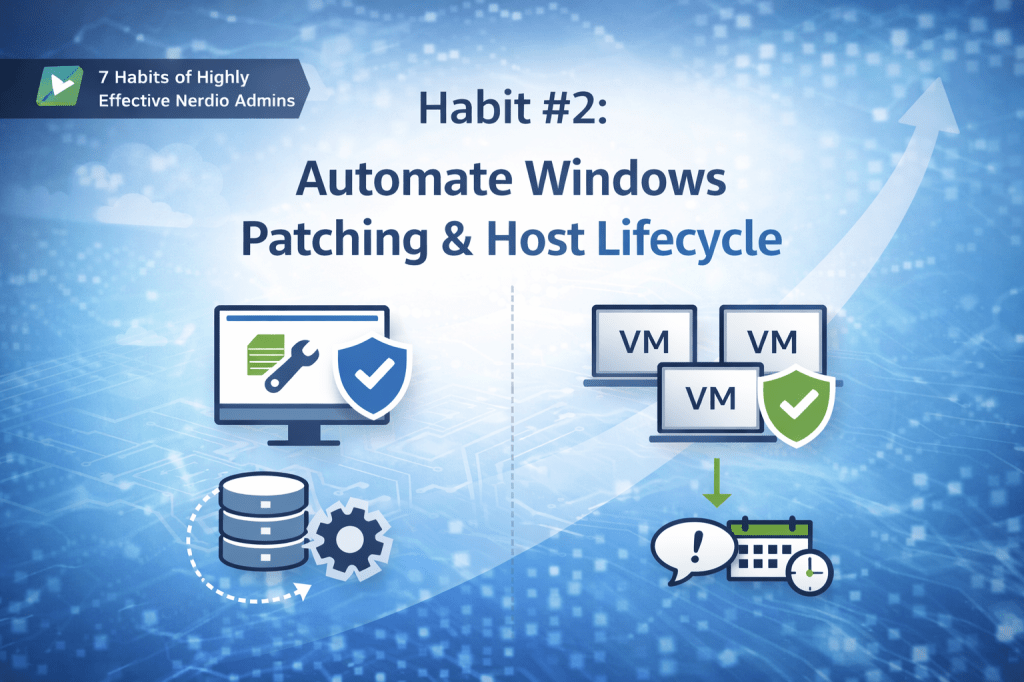
    Habit #2: Automate Windows Patching and Host Lifecycle

    Once desktop image management is standardised, most teams turn their attention to the next operational challenge: Windows patching.

    This is where many Azure Virtual Desktop environments begin to struggle.

    Manual patching is time-consuming, disruptive, and inconsistent. It often relies on individual knowledge, late-night maintenance windows, and a degree of luck. Highly effective admins take a different approach — they design patching as an automated, repeatable lifecycle, not a monthly fire drill.

    This is Habit #2.


    Why patching becomes a bottleneck at scale

    In smaller environments, manual patching can feel manageable. As environments grow, the cracks start to show.

    Common symptoms include:

    • Hosts patched at different times
    • Inconsistent patch levels across pools
    • Long or unpredictable maintenance windows
    • Uncertainty about what’s actually been updated

    The real issue isn’t effort — it’s risk. Inconsistent patching weakens security posture, complicates troubleshooting, and undermines confidence in automation elsewhere.


    The mindset shift: patching is a workflow, not a task

    Highly effective admins don’t think about patching as:

    “Applying updates to machines.”

    They think about it as:

    “A controlled workflow that updates images and hosts predictably.”

    That shift matters.

    When patching is treated as a workflow, you gain:

    • Predictability
    • Auditability
    • Confidence to automate safely

    This is where Nerdio Manager for Enterprise becomes an enabler rather than just a scheduling tool.


    One size does not fit all: patching strategy depends on host pool type

    One of the most common mistakes I see is applying the same patching strategy to every host pool, regardless of how it’s used.

    Highly effective admins make a clear distinction based on host pool type.


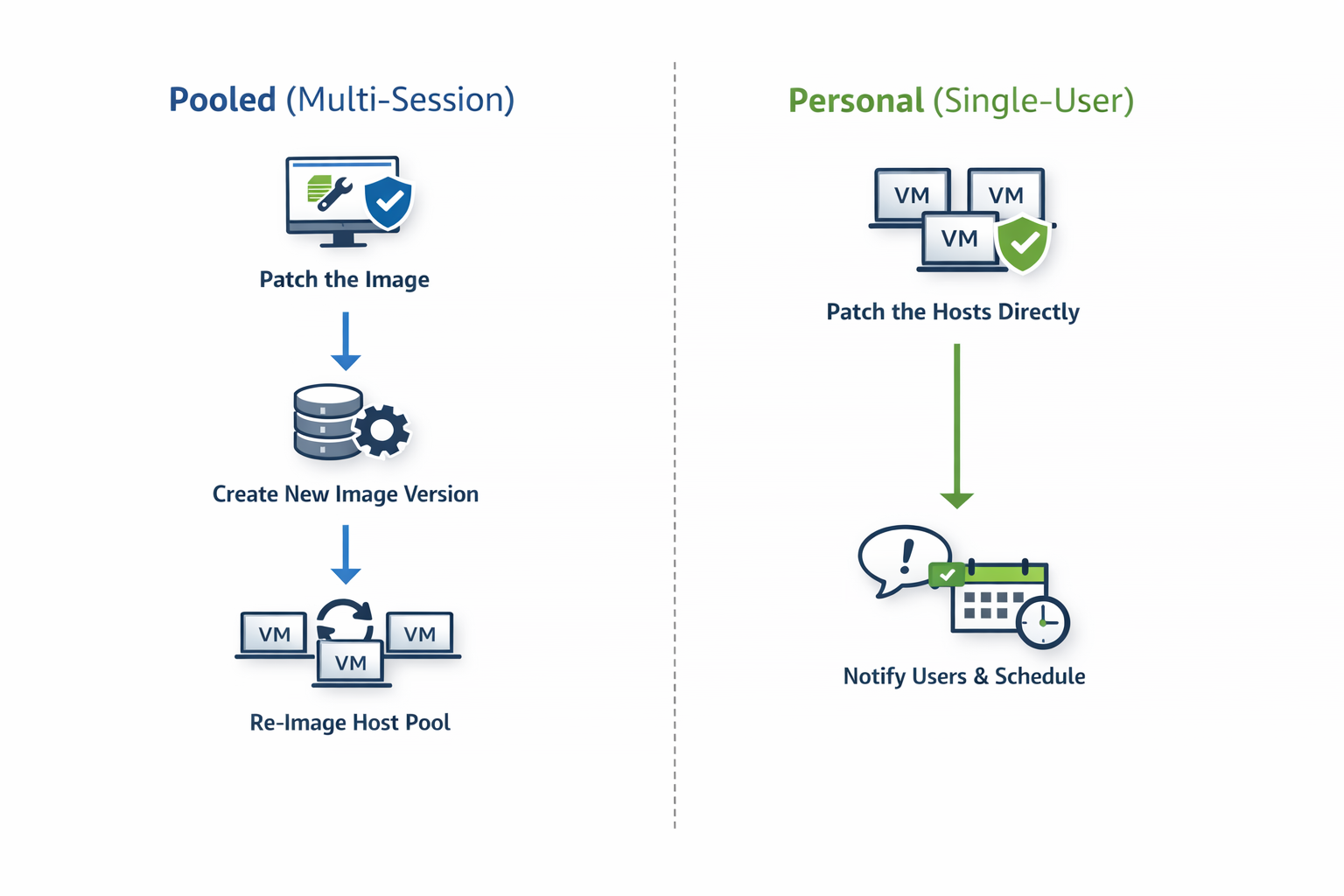
    Multi-session (pooled) host pools

    For multi-session environments, the recommended approach is simple:

    Patch the desktop image and re-image the session hosts

    This aligns naturally with how pooled AVD environments are designed.

    Why this works so well:

    • Session hosts are disposable by design
    • User data lives outside the VM (for example, FSLogix)
    • Re-imaging restores a clean, known-good baseline

    This approach delivers:

    • Consistent patch levels across all hosts
    • Faster recovery from issues
    • Cleaner environments over time

    In mature pooled environments, re-imaging is not disruptive — it’s expected.


    Personal host pools

    Personal desktops are fundamentally different.

    Because:

    • Each VM is tied to an individual user
    • Local applications or user-specific state may exist on the VM

    The recommended approach is:

    Patch the session hosts directly

    Re-imaging personal desktops can introduce unnecessary risk and user disruption. Patching hosts in place preserves:

    • User data
    • Personal configuration
    • Application state

    When combined with:

    • Drain mode
    • User notifications
    • Controlled scheduling

    …this approach keeps personal desktops secure without breaking the user experience.

    pooled vs personal patching

    The guiding principle

    Highly effective admins follow a simple rule:

    • If the host is disposable → patch the image and rebuild
    • If the host contains user state → patch the host directly

    This decision is baked into their operating model, not revisited every month.


    Why Patch Tuesday still matters

    Automation doesn’t mean patching at random.

    Highly effective admins align patching to:

    • Microsoft’s Patch Tuesday cadence
    • A predictable offset (for example, a few days later)
    • Known maintenance windows

    This creates:

    • Operational rhythm
    • Predictable change windows
    • Fewer surprises for users and support teams

    Automation doesn’t remove control — it formalises it.


    Automating the host lifecycle safely

    Patching doesn’t exist in isolation. It directly affects:

    • Host availability
    • User experience
    • Auto-scale behaviour

    That’s why effective admins automate patching together with host lifecycle controls, such as:

    • Draining sessions before maintenance
    • Controlling concurrency
    • Aborting safely after defined failures
    • Re-imaging hosts in a controlled sequence

    The objective isn’t speed — it’s controlled change at scale.


    The operational payoff

    When patching and host lifecycle management are automated correctly:

    • Hosts remain consistent
    • Security posture improves
    • Maintenance becomes predictable
    • Admin effort drops dramatically

    More importantly, teams gain confidence to:

    • Scale environments
    • Trust automation
    • Focus on optimisation rather than upkeep

    How this builds on Habit #1

    Habit #2 only works because Habit #1 exists.

    Without:

    • Standardised images
    • Versioning
    • Clear governance

    …patch automation becomes risky.

    With those foundations in place, patching becomes:

    • Safe
    • Repeatable
    • Boring (in the best possible way)

    Final thoughts

    Highly effective Nerdio admins don’t patch reactively.

    They:

    • Choose the right patching strategy per host pool
    • Align to predictable schedules
    • Automate patching as a lifecycle
    • Let the platform do the heavy lifting

    This is where operational maturity starts delivering real returns.


    This article is part of an ongoing series exploring the 7 Habits of Highly Effective Nerdio Admins. Upcoming deep-dives will cover application management, autoscale optimisation, right-sizing, and cost visibility.