Once desktop images are standardised and patching is automated, many environments hit the next friction point: application management.
This is often where complexity quietly creeps back in.
Applications are installed in different ways, updated inconsistently, and tied to specific images or host pools “just to make things work.” Over time, this undermines the stability gained from good image and patch discipline.
Highly effective admins avoid this by treating application management as a centralised, automated operating model — not a collection of one-off installs.
This is Habit #3.
Why application sprawl undermines otherwise well-run environments
In less mature AVD environments, application delivery tends to evolve organically:
- Some apps are baked into images
- Others are installed manually
- Updates are handled inconsistently
- Different teams use different tools
Initially, this can feel flexible. At scale, it becomes fragile.
Common symptoms include:
- Bloated desktop images
- Longer image rebuild and testing cycles
- Unclear ownership of applications
- Increased support tickets following updates
The issue isn’t the tools — it’s the lack of a consistent operating model.
The mindset shift: applications should not define your images
Highly effective admins make a deliberate separation:
Images provide the foundation. Applications provide the functionality.
When applications are tightly coupled to images:
- Every app update forces an image change
- Testing effort increases
- Rollbacks become harder and riskier
Decoupling applications from images allows teams to:
- Keep images minimal and stable
- Update applications independently
- Reduce the blast radius when something breaks
This is where Nerdio Manager for Enterprise becomes a control plane for application delivery — not just a place to manage hosts.
The three pillars of Habit #3
Highly effective admins consistently apply three principles when managing applications.
Pillar 1: Decouple applications from desktop images
Images should change slowly. Applications often don’t.
Highly effective admins:
- Avoid baking applications into images unless there’s a clear technical reason
- Keep images focused on OS configuration, runtimes, and baseline security
- Allow applications to evolve independently of the image lifecycle
This results in:
- Faster image rebuilds
- Lower testing overhead
- More predictable recovery and rollback
Key idea:
Images provide stability. Applications provide flexibility.
Pillar 2: Centralise app delivery into a single operating model
Modern AVD environments require flexibility. Different applications need different deployment approaches.
Highly effective admins embrace this reality — but they manage it centrally, rather than allowing application delivery to fragment.
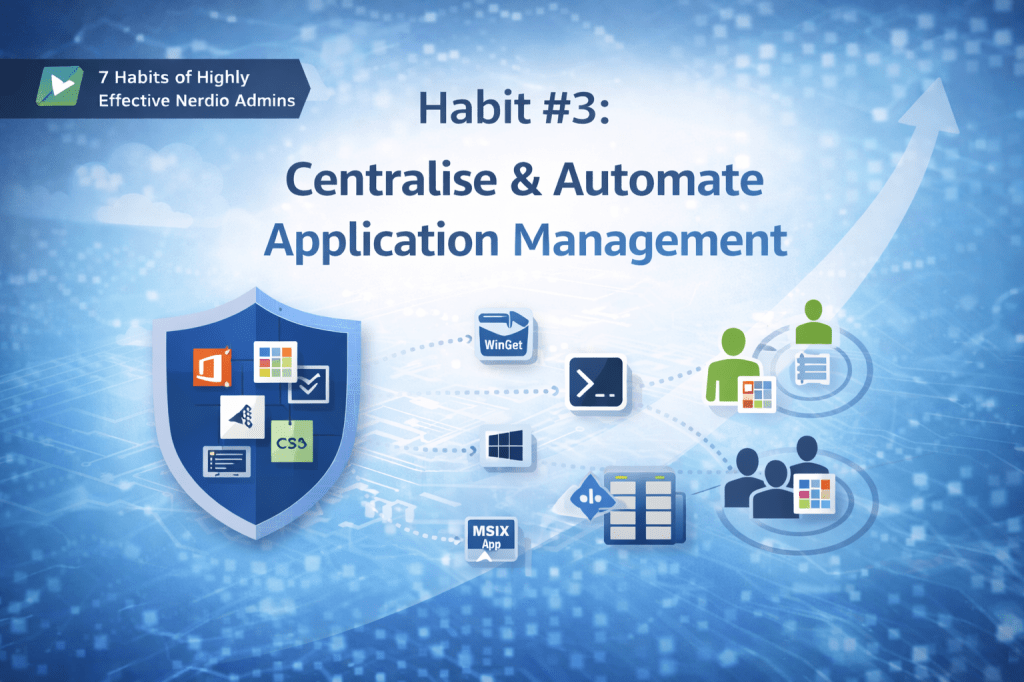
This may include:
- Public or private WinGet packages
- Scripted installs using Shell Apps or Scripted Actions
- Intune-managed applications
- MSIX app attach (where it makes sense)
- Legacy tooling where required, such as SCCM
The critical point isn’t which method is used — it’s that:
- The choice is intentional
- Deployment is automated
- Behaviour is predictable
Centralisation provides:
- Clear visibility into how applications are delivered
- Consistent update behaviour across environments
- Faster troubleshooting when issues arise
The result is flexibility without fragmentation.
Key idea:
Different tools. One control plane.
Pillar 3: Assign applications by intent, not infrastructure
A common anti-pattern is allowing application differences to dictate:
- New images
- New host pools
- Environment-specific workarounds
Highly effective admins avoid this by assigning applications based on intent, such as:
- User role
- Team or department
- Business requirement
Instead of asking:
“Which host gets this app?”
They ask:
“Who actually needs this app?”
This approach:
- Reduces image and host pool sprawl
- Simplifies onboarding and offboarding
- Keeps environments easier to reason about
Importantly, this does not require App Attach. User- or group-based assignment can be achieved through multiple delivery methods, with App Attach used selectively where it provides clear value.
Key idea:
Apps should be delivered by need — not by where a user logs in.
Automate application updates deliberately
Application updates are one of the most common sources of instability.
Highly effective admins:
- Automate updates where appropriate
- Control timing and scope
- Avoid surprise changes during business hours
Just like OS patching, application updates work best when treated as a repeatable workflow, not an ad-hoc task.
Automation doesn’t remove control — it formalises it.
The operational payoff
When application management is centralised and automated:
- Images remain lean
- Updates become predictable
- Rollbacks are simpler
- Administrative effort drops significantly
More importantly, teams gain confidence to:
- Introduce new applications faster
- Standardise environments
- Scale without increasing complexity
How Habit #3 builds on Habits #1 and #2
Habit #3 only works because the earlier habits are already in place:
- Habit #1 stabilises the image
- Habit #2 stabilises the host lifecycle
With those foundations:
- Applications can be delivered independently
- Updates don’t force image rebuilds
- Failures are isolated and recoverable
Each habit compounds the value of the last.
Final thoughts
Highly effective Nerdio admins don’t let applications drive infrastructure design.
They:
- Decouple applications from images
- Centralise delivery
- Assign applications by intent
- Automate updates predictably
This is how AVD environments remain flexible without becoming fragile.
This article is part of an ongoing series exploring the 7 Habits of Highly Effective Nerdio Admins. Upcoming deep-dives will cover autoscale optimisation, right-sizing, and cost visibility.

Leave a comment