Tag: FSLogix

  • FSLogix: What Belongs in a Profile, What Doesn’t, and How to Keep It That Way

    FSLogix: What Belongs in a Profile, What Doesn’t, and How to Keep It That Way

    Four questions come up in nearly every FSLogix health check I run. What should be in the profile. What shouldn’t. How big it needs to be. And why it keeps growing even after someone swears they turned on cleanup.

    This week I’ve gone through the first three on LinkedIn: the beliefs that quietly cost money, what actually happens at logon, and the config I’d set before a single user signs in. This post is everything in one place, with the registry paths, so you can check your own environment against it rather than take my word for it.

    What FSLogix actually does

    Skip this if you already know it, but it’s worth thirty seconds because it explains almost everything downstream.

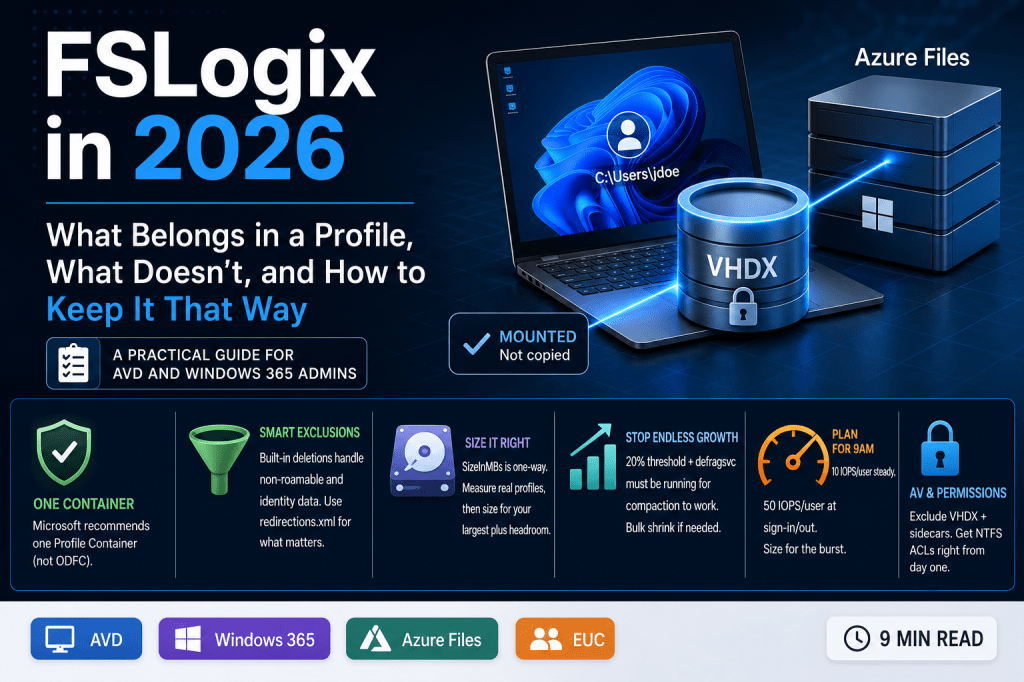
    FSLogix doesn’t copy a profile to the session host the way old-style roaming profiles did. It mounts a VHD or VHDX file from a network share and attaches it at the file system level using a kernel driver. Windows sees C:\Users\<username> and has no idea it’s actually a disk sitting on Azure Files or a file server somewhere else. No copy at logon, no copy at logoff. That’s why it’s fast, and it’s also why almost every strange failure traces back to that mounted disk: what’s inside it, how big it’s allowed to get, and whether the network path stays up for the whole session.

    What belongs in the container, and what doesn’t

    Microsoft’s own guidance has settled on a single answer here: use one Profile Container that holds everything, rather than splitting profile data from Office data into a separate ODFC container. ODFC exists for organisations already running a different profile solution and using FSLogix only for Office data. If that’s not your situation, one container is simpler, and it’s what Microsoft recommends.

    Inside that container, two things get handled for you automatically, and it’s worth knowing about them rather than assuming they don’t exist.

    Deletion-based exclusions. Non-roamable app data (MSIX package cache, temp state) gets stripped out at logoff so it never bloats the container. More importantly, identity data tied to the device itself — Entra broker tokens, TokenBroker, OneAuth, the AAD registry keys — is excluded by design. There’s a setting called RoamIdentity that looks like it would fix Entra sign-in quirks by roaming that data instead. Don’t touch it. Microsoft is explicit: never enable RoamIdentity on an Entra-joined or Intune-managed device. It ties identity to the wrong thing, and you’ll get worse authentication problems than whatever you were trying to fix.

    Custom exclusions via redirections.xml. If you need to exclude something Microsoft doesn’t already handle, this is the mechanism — an XML file, deployed centrally via RedirXMLSourceFolder, that lists paths to exclude or redirect. Microsoft’s own warning on this page is worth repeating verbatim: profile data isn’t designed to be removed, and unless you understand the application well, don’t exclude it. Every well-known FSLogix teardown agrees on the same short list worth actually redirecting: browser cache, the Outlook OST, OneDrive’s sync cache, and Teams. Beyond that, keep the file short. Every redirection is I/O overhead multiplied by every signed-in user.

    Two of Microsoft’s own defaults are worth knowing precisely because they surprise people. IncludeTeams in ODFC settings defaults to 0 — Teams data isn’t redirected unless you turn it on, and for the current MSIX-based Teams client you need this set for the app to even register correctly at sign-in. And RoamSearch, the setting that roams the Windows Search index inside the container, is something Microsoft now says isn’t needed on Windows Server 2019 (1809+), Windows 10, or Windows 11 multi-session. It solved a real problem years ago. On a modern image, it mostly adds I/O.

    Sizing that actually works

    SizeInMBs defaults to 30,000, roughly 30 GB, and it’s a one-way setting. Raise it and every existing container expands to match on next logon. Lower it and nothing happens — it has zero effect on containers that already exist. The only way down is compaction or rebuilding the container from scratch.

    Keep IsDynamic at its default of 1. A dynamic VHDX starts small and grows as data is written; a fixed one allocates the full size immediately and can never be compacted. There’s no scenario where fixed is the better choice for a profile container.

    Thirty gigabytes is a reasonable starting point, not a number to trust blindly. A light knowledge worker with a small OST and everything else in OneDrive might genuinely need 10 to 15 GB. Someone with a large mailbox and local app data can eat 60 GB without anything unusual happening. Measure actual profile sizes on your existing share before you commit to a number, and size for the largest real profile you have plus headroom, not for a round figure that felt safe when the host pool was built.

    Why containers grow and never shrink on their own

    This is the one that catches people out months after go-live. When a user deletes files inside their profile, FSLogix marks the space as free inside the VHDX. The file on the share stays exactly the same size. Nothing shrinks by itself. A profile that briefly ballooned to 25 GB during a big OneDrive sync stays at 25 GB on disk forever, even after the sync settles down.

    Built-in compaction exists to fix this and runs automatically at every sign-out, but it has two conditions that quietly stop it working, and neither produces an error when they do.

    First, it only runs if at least 20% of the consumed space is recoverable. A container using 12 GB with a 10 GB minimum supportable size has 2 GB recoverable, which is under the 2.4 GB threshold — so compaction skips it silently every time, and the profile never gets smaller.
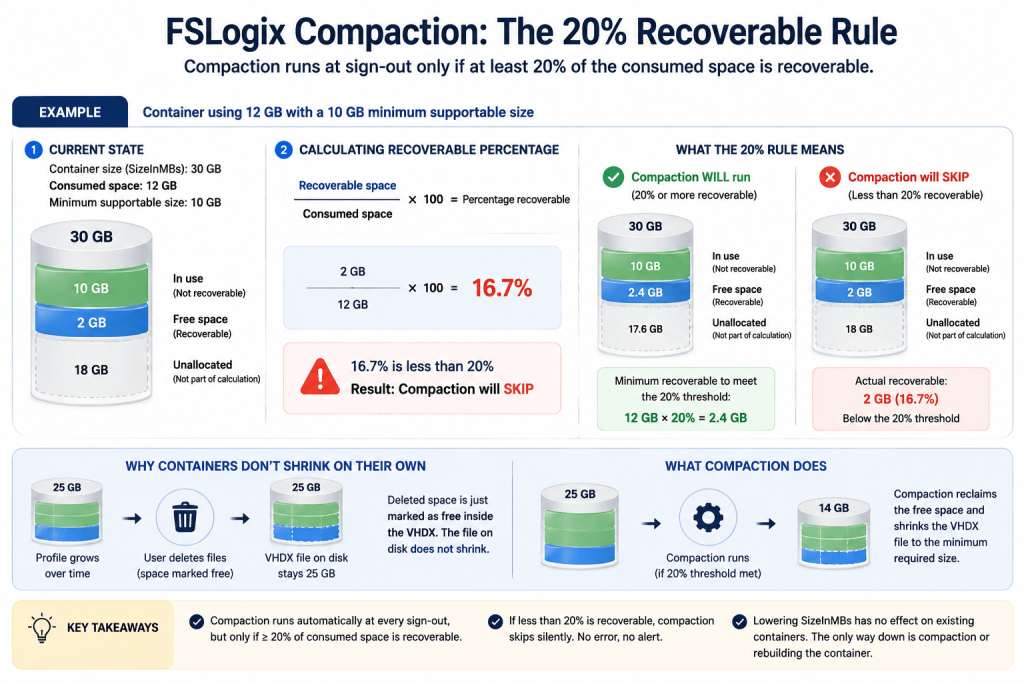
    Second, compaction depends on the Windows Optimize Drives service, defragsvc. If that service is set to Disabled anywhere in your image, which is common in hardened builds, FSLogix can’t query the minimum supportable size, and compaction doesn’t run at all. No error, no log entry that jumps out. It just quietly does nothing every single sign-out.

    If you’re maintaining an older estate where containers have already ballooned past what per-sign-out compaction can claw back, both the community Invoke-FslShrinkDisk script and Nerdio Manager’s built-in “Shrink FSLogix Profiles” scripted action exist to do a bulk pass offline. Worth knowing the community script sits in the FSLogix GitHub organisation and isn’t a Microsoft-supported product feature — test it before you trust it against production data.

    One more setting worth turning on while you’re in there: CleanupInvalidSessions, which ships disabled. It has FSLogix clean up stale artefacts left behind by sessions that ended abruptly rather than signing out cleanly, and it’s a small thing that prevents a class of “why won’t this profile attach” tickets later.

    Storage, and the 9am problem

    Microsoft’s IOPS guidance for FSLogix is specific: budget 10 IOPS per user at steady state, and 50 IOPS per user during sign-in or sign-out. For 100 users, that’s roughly 1,000 IOPS most of the day and a burst toward 5,000 IOPS in the window everyone arrives at once. Size for the burst, not the average, or the first twenty minutes of every morning will be the worst part of your users’ day.

    On tier, Microsoft’s own workload table draws the line at 200 users for the “Light” category: under 200 light users, Azure Files Standard can work. Above that, or for anything heavier than light, Premium is the recommendation regardless of headcount. Standard is priced on transactions as well as capacity, which makes its performance genuinely variable under load — not what you want for something every user depends on to log in.

    The failure modes worth knowing before they bite

    Wrong FSLogix permissions are, by most practitioner accounts I trust, the single biggest generator of AVD support tickets. Get the NTFS ACLs on the share root right from day one: modify for the user group, full control for admins, and Creator Owner set to modify on subfolders and files only so each user’s own container inherits correctly. Exclude admin accounts from FSLogix profiles entirely — if something goes wrong, you want an unencumbered way in to fix it.

    Antivirus exclusions are the other classic. It’s not just the VHD or VHDX file itself. The small sidecar files sitting next to it on the share — .VHD.lock, .VHD.meta, .VHD.metadata and their VHDX equivalents — need the same exclusion, or AV locking them produces the exact same sharing violations and temp profiles as locking the disk file. A logon storm with twenty users all having their containers scanned at once is a fast way to bring a host to its knees.

    Two authentication issues are worth knowing about specifically because they’re recent and easy to miss. Microsoft’s Kerberos hardening, moving domain controllers to require AES-SHA1 instead of RC4 for objects with no encryption type explicitly set, took effect with the April 2026 cumulative update, and the audit-mode rollback that let you defer it was removed at the end of July. If your profiles sit on an on-premises SMB share, or on Azure Files using AD DS authentication, and anything in that chain is still RC4 or has no encryption type set, it breaks. Entra Kerberos authentication isn’t affected by this particular change.

    Entra Kerberos has its own separate limitation worth planning around if you’re cloud-native: the ticket that authorises access to Azure Files lasts about 10 hours, and Entra ID currently can’t renew it. Cross that mark in a single session and the container drops, usually with a bad username or password error that has nothing to do with the actual password. Microsoft’s documented fix is cloud trust, issuing tickets from AD DS instead — which isn’t an option if you’re genuinely Entra-only. If that’s your situation and you have users on long shifts, budget time to look at a scheduled ticket refresh as a workaround.

    Cloud Cache: when it earns the extra complexity

    Cloud Cache sits on top of the profile container and changes where the writes go. Instead of writing straight to the network share, it writes to a local cache on the session host first and syncs to one or more remote storage providers in the background. Microsoft positions it for multi-region deployments and for keeping users working through a storage outage — genuine high availability, not a substitute for backup and restore.

    It’s not free. It needs fast local storage for the cache, adds a few seconds to logon, and on non-persistent session hosts that get rebuilt regularly, the local cache is gone every time — meaning every logon rehydrates fully from remote storage anyway, which defeats the point. For a single-region deployment already sitting on Zone Redundant Azure Files Premium, the honest answer is usually that Cloud Cache adds complexity without adding much you didn’t already have.

    Where none of this applies

    Windows 365 Cloud PCs don’t use FSLogix profile containers, and this trips people up when they’ve spent years thinking in AVD terms. A Cloud PC is persistent and assigned 1:1 to one user. The profile lives on the Cloud PC itself between sessions, the same way it would on a physical laptop, so there’s nothing to roam.

    The same logic extends further than most people realise. AVD Personal host pools work the same way: one session host assigned persistently to one user. Microsoft’s own guidance on when a roamed profile is genuinely needed centres on pooled host pools, where a user might land on a different host every time they sign in — the scenario a persistent, dedicated assignment simply doesn’t create. I haven’t found a Microsoft page that states this as flatly as I’d like, so take it as my reading of how the mechanism works rather than a quoted policy: on a Personal host pool, FSLogix is there for convenience and portability, not because the architecture requires it the way a pooled deployment does.

    Doing this at scale

    Everything above is something you can configure by hand through Group Policy and the registry, and for a single host pool that’s entirely reasonable. Where it gets tedious is doing it consistently across a growing estate, and keeping it consistent as new host pools get added.

    Nerdio Manager applies FSLogix configuration as policy at the host pool level rather than per-image, and ships the offline compaction runbook mentioned above as a built-in scripted action rather than something you maintain yourself. If you’re already on NME, it’s worth checking those settings are actually being applied the way you think they are rather than assuming the defaults match what’s above.

    Where to start

    If you only do three things after reading this: check whether defragsvc is disabled anywhere in your image, add the sidecar file exclusions to your antivirus policy, and measure real profile sizes on your share before you next touch SizeInMBs. None of them take an afternoon, and each one is a support ticket you won’t get later.
  • How to run Azure Virtual Desktop with cloud-only and external identities using FSLogix

    How to run Azure Virtual Desktop with cloud-only and external identities using FSLogix

    If you’ve ever tried to stand up Azure Virtual Desktop in a properly cloud-native tenant, with no on-premises Active Directory and no Entra Domain Services, you’ll know where it falls over. Not the session hosts. Not the networking. The profiles.

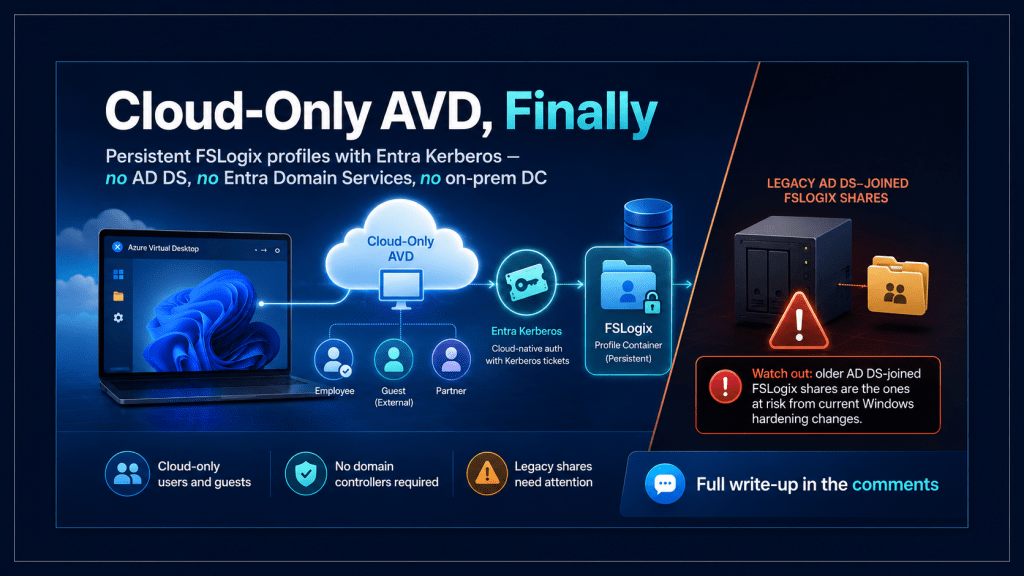
    FSLogix has needed some form of Active Directory for years, which made it the one component that kept dragging a “cloud-only” AVD design back towards a domain controller. That’s now changed. FSLogix profile containers on Azure Files can authenticate with Microsoft Entra Kerberos, which means cloud-only users, and even external guest users, can get a real, persistent profile with no domain controller anywhere in the picture.

    This post covers how to set that up end-to-end. It also covers the part that isn’t in the announcement posts: a Windows Kerberos hardening change landing in 2026 that can break FSLogix profile access on Active Directory-integrated storage, including shares you built years ago. It’s a good reason to understand the cloud-only path, because that path sidesteps the whole problem. Read that section before you touch production.

    The problem cloud-only AVD always hit

    FSLogix works by redirecting the user’s profile into a VHD(X) container on an SMB file share, then attaching it at sign-in. On a pooled host pool, that’s what gives a user the same desktop, settings, and Outlook cache on whichever session host they land on.

    The catch was always authentication to that file share. Azure Files historically required on-premises AD DS or Entra Domain Services to handle the Kerberos side. In a tenant that had neither, your options were ugly: stand up Entra Domain Services purely to host profiles, or accept that cloud-only and guest users got a fresh temporary profile every session. No roaming, no persistence, no cached sign-ins. For a genuinely cloud-first organisation, that was the line item that stopped the whole design from being clean.

    What Entra Kerberos changes

    Microsoft Entra Kerberos lets Entra ID issue the Kerberos tickets needed to reach an Azure Files share over SMB, without any domain controller involved. Applied to FSLogix, which unlocks three identity types on Azure Files:

    • Hybrid identities from Entra joined, or Entra hybrid joined session hosts, with no network line-of-sight to a domain controller. Supported in Azure commercial, Azure for US Government, and Azure operated by 21Vianet.
    • Cloud-only identities (users who only exist in Entra ID and never in an on-premises AD).
    • External identities (B2B guests invited into your tenant).

    The cloud-only and external paths are supported in the Azure commercial cloud only. If you’re running in US Gov or 21Vianet, only the hybrid path is available to you, so don’t design around cloud-only profiles there.

    The practical upshot: a pure Entra-joined session host can now load a persistent FSLogix profile for a user who has never existed in an on-premises directory. That’s the missing piece for cloud-native AVD, and it’s genuinely useful for any estate that hands desktops to contractors or partners as guests.

    Read this first: the RC4 to AES-SHA1 change

    Here’s the bit that isn’t in the launch coverage, and the reason I’d check your existing estate before building anything new.

    Starting with the April 2026 Windows cumulative update, Kerberos default behaviour changes. When an Active Directory object’s encryption type is left unset (null), Windows defaults to AES-SHA1 instead of the legacy behaviour that often landed on RC4. This is a Windows platform security change tied to CVE-2026-20833, and to be clear, the Azure Virtual Desktop service itself isn’t being modified.

    The thing to understand is what’s actually in scope. This affects FSLogix profile storage that authenticates over SMB integrated with Active Directory: on-premises AD, a NAS, a file server, or Azure Files joined to AD DS, where the relevant AD objects or service accounts are RC4-only or have encryption left null. If a dependent system doesn’t support AES-SHA1 for Kerberos, authentication can fail, and profiles can stop loading.

    Notice what’s not on that list: a pure Entra Kerberos, cloud-only share. Entra Kerberos isn’t AD Kerberos, so by the mechanism described, the cloud-only path in this post sidesteps this particular change. The deployments most exposed are the older, domain-joined FSLogix shares, exactly the ones a cloud-native design is trying to move away from. If you’re migrating off a hybrid AD DS setup, the legacy share is the thing to remediate before you decommission it.

    One caveat on that, because the two Microsoft sources don’t word it identically. The FSLogix product documentation states the warning more broadly: file shares hosting FSLogix containers that aren’t upgraded to AES-SHA1 might have access issues, and customers who have already moved to AES-SHA1 aren’t affected. The detailed hardening blog is the one that ties the actual mechanism to AD object encryption and AD-integrated SMB storage. I read the technical scope as AD-Kerberos paths, which is why I’m calling out the domain-joined shares specifically, but the safe operational rule Microsoft is pushing is simpler: make sure any Azure Files share holding FSLogix profiles is on AES-SHA1, and validate it, rather than assuming you’re exempt. If you’re not certain which Kerberos path a given share uses, treat it as in scope and check.

    The timeline matters. From April 2026, enforcement mode is the default on domain controllers, with audit mode available as a manual rollback until July 2026. From July 2026, audit mode is removed, and enforcement is the only option. Microsoft recommends remediating by the end of June 2026, especially for non-Azure Files SMB storage and Azure Files with AD DS.

    So before anything else: identify RC4 usage and null encryption settings on the AD objects tied to your FSLogix storage, move them to AES-SHA1, and validate sign-in and profile load end-to-end. Microsoft’s FSLogix blog (“Action required: Windows Kerberos hardening (RC4) may affect FSLogix profiles on SMB storage”) is worth ten minutes before any of the steps below.

    Setting it up: the storage account

    With that warning logged, here’s the build. Start with the Azure Files side.

    First, a constraint that catches people out: a storage account can authenticate with one identity method only. Entra Kerberos, or AD DS, or Entra Domain Services, not a mix. If your account is already wired to AD DS for an existing share, you can’t bolt Entra Kerberos onto the same account.

    The sequence on the storage account is:

    1. Create the storage account and an Azure Files share for the profiles, if you don’t already have them.
    2. Enable Microsoft Entra Kerberos authentication on the storage account. This creates the Entra ID app registration for the account and lets you assign permissions to Entra groups.
    3. Assign share-level permissions, either through the default share-level permission on the identity source page or with Azure RBAC roles.
    4. Configure the directory and file-level permissions for the profile containers, following Microsoft’s recommended FSLogix permission set, so users can create and use their own profile while admins retain management access. For cloud-only and external users, you do this through the Manage access control on the share.
    5. Grant admin consent to the new service principal, so users can request Entra tokens for the storage account.
    6. Disable multifactor authentication on the storage account.

    That last one always raises an eyebrow, so it’s worth being clear about why. The Kerberos ticket is acquired silently during sign-in, and there’s no interface at that point to perform a step-up MFA prompt. If MFA is enforced on the storage account, the silent ticket request fails, and the profile won’t mount. You’re not weakening user sign-in MFA here; Conditional Access on the user still applies. You’re allowing the storage account’s own token acquisition to complete without a step-up, it has no way to satisfy.

    Setting it up: the session host

    Now the session host. The profile won’t attach until the host knows to fetch a cloud Kerberos ticket at logon.

    Enable CloudKerberosTicketRetrievalEnabled using whichever of these fits your management approach:

    • Intune Settings Catalog (the modern route): the Kerberos Policy CSP setting CloudKerberosTicketRetrievalEnabled. Worth noting that Windows multi-session client editions now support this setting when it’s applied through the Settings Catalog, which wasn’t always the case.
    • Group Policy: Administrative Templates\System\Kerberos\Allow retrieving the cloud kerberos ticket during the logon.
    • Registry, if you’re baking it into an image:
    reg add HKLM\SYSTEM\CurrentControlSet\Control\Lsa\Kerberos\Parameters /v CloudKerberosTicketRetrievalEnabled /t REG_DWORD /d 1

    Next, let the FSLogix credential keys roam. When you use Entra ID with a roaming profile, the Credential Manager keys have to belong to the profile that’s currently loading, otherwise you’re effectively pinned to one machine. Set:

    reg add HKLM\Software\Policies\Microsoft\AzureADAccount /v LoadCredKeyFromProfile /t REG_DWORD /d 1

    Then the FSLogix configuration itself. If your session hosts were built by the Azure Virtual Desktop service, FSLogix is already installed. Set the usual two values:

    • Enabled = 1
    • VHDLocations = \\<storage-account-name>.file.core.windows.net\<file-share-name>

    Sign in with a test account that’s been assigned to an app group on the host pool and has permission to the share. If it’s worked, you’ll see a directory on the share named like <user SID>_<username>. Use a fresh test account, or enable DeleteLocalProfileWhenVHDShouldApply, so an existing local profile doesn’t mask whether the container is actually mounted.

    The cloud-only step everyone misses

    If your users are cloud-only and you assign share access by Entra group, there’s one more step that is easy to skip and fails silently when you do.

    You have to add an app manifest tag to the storage account’s Entra app registration so that Entra includes cloud-only group SIDs in the Kerberos ticket. Without it, Entra only puts on-premises group SIDs in the ticket; your cloud-only groups never appear, and group-based permissions to the share simply don’t take effect. No error that points to the cause, just access that doesn’t work.

    In the app registration manifest, add kdc_enable_cloud_group_sids to the tags array. This step is mandatory for cloud-only identities. Hybrid identities don’t need it, which is exactly why it catches people moving from a hybrid design to a cloud-only one. The thing that worked before now quietly doesn’t, and the difference is one manifest tag.

    External identities: real, but mind the preview line

    External (guest) identity support is the newest part of this story, and it’s worth being precise about what’s actually shipped. Connecting to Azure Virtual Desktop and Windows 365 with an external identity is generally available. Using FSLogix to give those external identities a persistent profile is still in public preview.

    That distinction matters if you’re planning a rollout. A contractor can sign in to your AVD environment today on a fully supported path. Giving them a roaming FSLogix profile that follows them across session hosts is the preview part, so treat it accordingly: pilot it with a small guest cohort, don’t promise it in a contract yet.

    A few requirements specific to external identities are easy to miss. Microsoft Entra single sign-on must be configured for the connection. The session host has to be Entra joined and running Windows 11, version 24H2 or later with the September 2025 cumulative update (KB5065789) or newer. And for Azure Virtual Desktop, you also have to assign the Virtual Machine User Login Azure RBAC role to the external identity on the VMs they’ll sign in to, which you don’t have to think about for your own member users. It’s commercial-cloud only, like the cloud-only path.

    Wrapping up

    Cloud-only and external identity support for FSLogix removes the last real reason a cloud-native AVD design had to drag a domain controller, or Entra Domain Services, along for the ride. For genuinely cloud-first organisations, that’s a meaningful simplification, and for anyone serving guests, it opens a door that used to be shut.

    Just sequence it correctly. If you’ve still got legacy FSLogix storage joined to AD DS, sort out the RC4 to AES-SHA1 migration on it before the Windows enforcement deadlines force the issue, because that’s the part that affects deployments you’ve already got running. The cloud-only Entra Kerberos path you’re building towards doesn’t carry that particular baggage, which is one more reason to make the move. And if your use case is external guests, remember the FSLogix profile piece is still in preview, so pilot before you promise.

    If you’re running cloud-only AVD already, or about to, I’d genuinely like to know how the external-identity profiles are holding up for you. Drop a comment.